
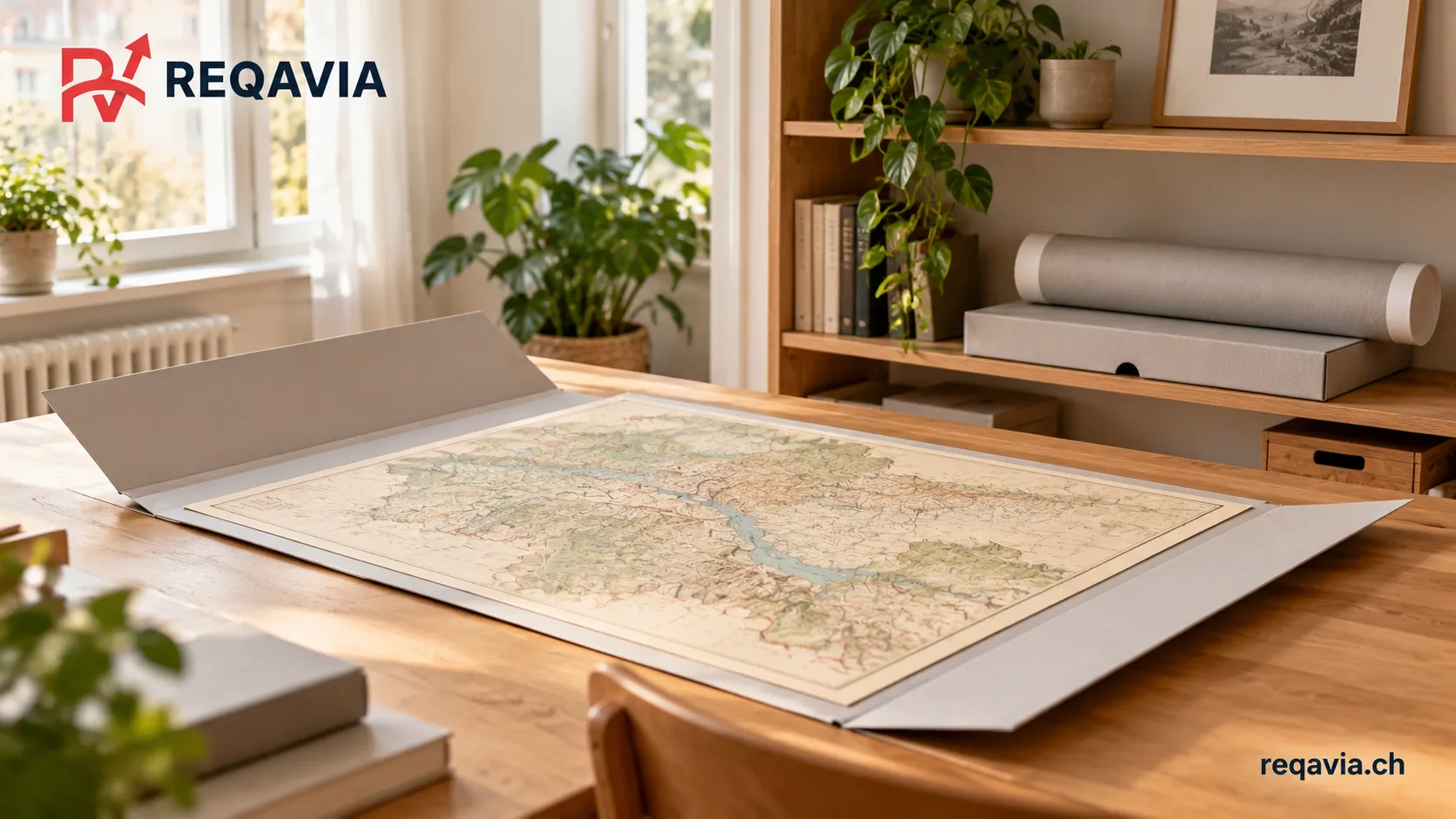
A large map or poster should not acquire a new fold simply because a suitable box is unavailable. First establish what you want to keep, its condition and how you expect to use it later. Then choose an appropriate enclosure and storage position. For a delicate original, obtain specialist advice before arranging the transport.
Start with the condition you can see
Record whether the item is a replaceable print, a personal keepsake, an old plan or an original. Note visible tears, distortion and loose image material without working on them. Measure only what you can reach without forcing the item open. A rolled or framed work need not be fully unpacked for your initial enquiry.
Flag information you cannot establish. If paper is brittle, layers are stuck or image material is flaking, have a paper conservator assess the handling. The Canadian Conservation Institute identifies particular protection needs for fragile or damaged works. Do not try to remove creases with moisture, heat or pressure.
Choose the storage form deliberately
First ask whether the sheet can be accommodated flat without a new fold. The US National Archives favour flat storage for large paper records and advise against cutting them to fit a container. If rolled storage is the only option being considered, have its suitability checked for this particular item. Length alone does not settle that question.
Compare more than the outside dimensions of containers. The complete item must fit, receive suitable support and remain retrievable. Establish who selects the enclosure and who packs it. A solution assessed as suitable for a simple reproduction is not automatically appropriate for a different work.
The Library of Congress recommends supportive enclosures but notes that sensitive image materials are incompatible with some sleeves. Tape, rubber bands and glue should not be applied directly to the paper. A general “acid-free” label therefore does not settle the entire packaging decision.
Treat the frame and identification separately
If the sheet is already framed, record the frame dimensions and visible condition. Treat removal from the frame as a separate decision, made before anyone takes it apart to save space. Ask whether the whole framed object can be suitably accommodated and how it will be handled.
Give each enclosure an identifier and keep a list of contents, format, known condition and intended location. Label the outer housing without sticking a label to the sheet. General photographs can help identification. Personal information visible in architectural plans or documents need not appear in a widely shared inventory.
Check the actual space and retrieval arrangements
Give the storage company the finished package dimensions, not just the paper size. Explain whether you need access during storage. Ask where the package will sit, how it will be retrieved and who will handle it. Appropriate packaging is of little help if a long parcel is later buried under furniture or can be reached only by rearranging everything.
Where a specialist has set particular preservation requirements, ask which conditions the company can actually meet. An ordinary storage service does not automatically include conservation oversight. Resolve essential uncertainties before confirming, rather than accept an unsuitable space because moving day is approaching.
Prepare a clear storage request
In your text-based request through REQAVIA, describe the item type, quantity, format, existing packaging, expected duration and access needs. Explicitly mention questions still requiring specialist assessment. You can share photographs directly and privately with the company during coordination.
REQAVIA is an intermediary: services, price and execution are agreed directly with the company. At retrieval, compare identifiers and visible condition with your inventory. Open delicate enclosures according to the agreed guidance instead of rushing to hang the item immediately.
Library of Congress: care and storage of works on paper