
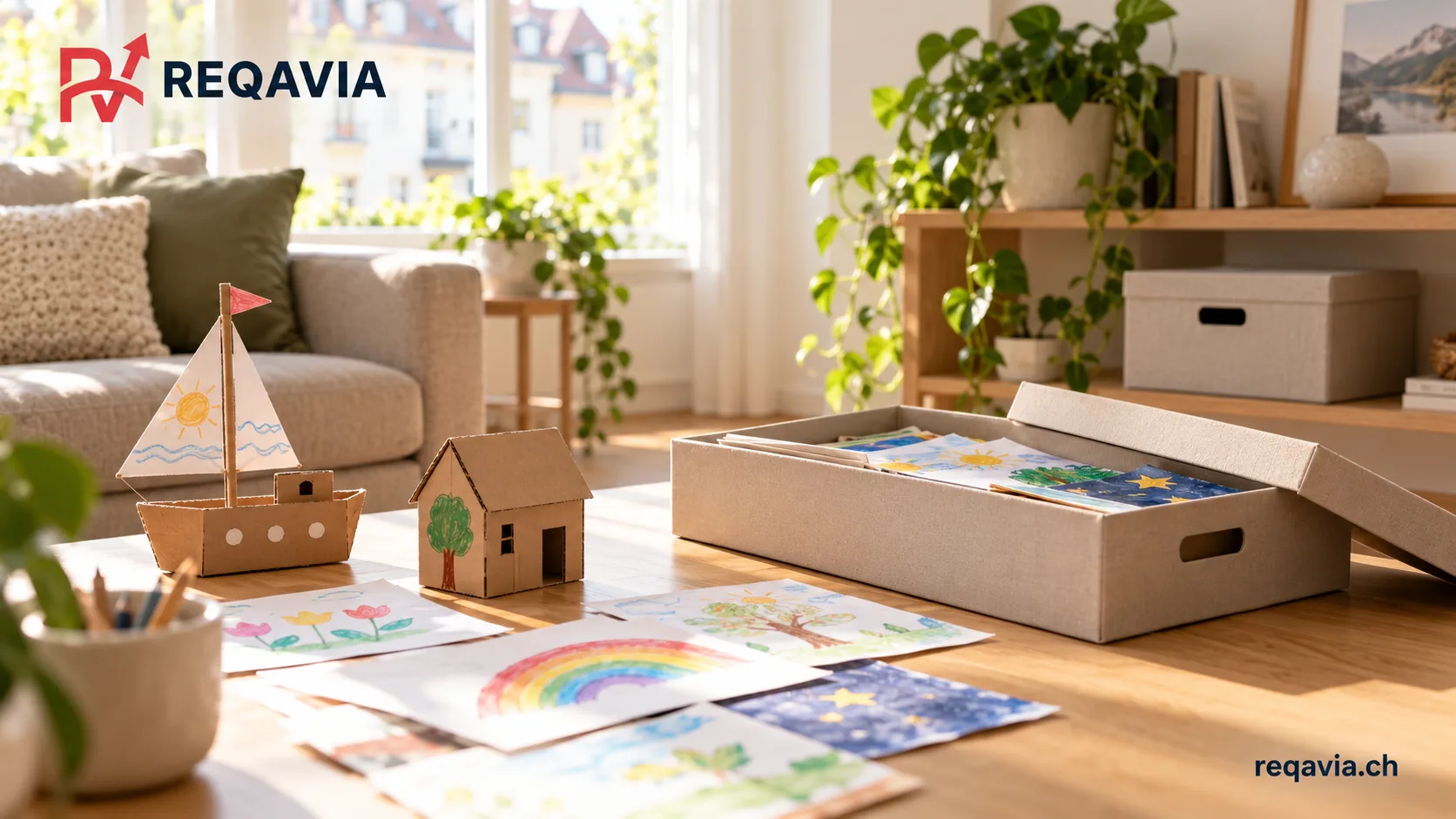
If school drawings and models have filled the cupboards, choose a manageable collection with your child before looking for more storage. Start with work from one period and agree where the selected pieces will fit. The aim is to keep objects and stories you expect to revisit. Renting space before making those choices can simply move the same unresolved pile elsewhere.
Make the decision small enough to finish
Set out one school term or one box on a clear surface. Ask which pieces the child wants to show you and what they remember about them. A roughly made model can matter more than a polished drawing. Explain the available space honestly, and adapt the choices to the child’s age and ability to participate. Do not promise to keep everything and then remove it secretly.
Use four temporary groups: keep the original, photograph and decide, still uncertain, and ready to leave. Give the uncertain group its own limited space and a date for another look. Let the child choose some pieces independently within the agreed space. Keep adults’ choices visible too, so nobody mistakes a parent’s favourite for the child’s decision.
Keep the story with the object
For each retained piece, note a short description, the period and any explanation the child wants remembered. Put that information in your inventory rather than writing on a delicate surface. A general box code can identify the collection without displaying a child’s full name or school on its exterior.
Photograph a bulky project from useful angles before deciding whether the original must stay. Check that the photographs are readable and that you can find them again. A photograph is a choice about what to preserve, not an equivalent replacement for every object. Keep the images private unless you make a separate decision to share them; school details and other children’s names may be visible.
Decide what kind of space the collection needs
Measure the largest selected models and the proposed containers. Count boxes only after sorting, and describe fragile projections, mixed materials or pieces that cannot be stacked. Compare keeping a small accessible collection at home with using external storage for selected larger items. Consider when you will want to revisit them and who will retrieve them, rather than comparing space alone.
Ask a storage company which materials it accepts and how the collection should be prepared. A school project can include more than paper and cardboard. Do not assume that acceptance of household boxes covers every substance inside a model. If you cannot identify a component, describe the uncertainty before agreeing to store it.
Prepare the selected work without improvising repairs
Choose packing that supports each object without crushing it. Do not put heavy boxes on fragile models or close damp work into a container. Separate pieces whose condition is unclear. For an especially fragile or valuable object, or one with unfamiliar materials, ask a suitable specialist about preservation before applying tape, cleaning products or a repair. The moving or storage company should confirm what preparation it can undertake.
For work that will leave the home, describe its materials and ask the relevant local collection point what it accepts. Do not dismantle unfamiliar components merely to fit a presumed recycling category.
Write a request the company can assess
Give the number and approximate dimensions of containers, the largest model, known materials, fragile parts, access at collection and your expected storage period. Explain which packing tasks you need and whether occasional retrieval matters. Ask about acceptance, handling, access and the complete agreed scope.
You can describe this storage need through REQAVIA. It is an intermediary; prices, arrangements and execution are agreed directly with the company. Use the text description in the request. If photographs would help explain a delicate model, share them privately with the company during coordination.