
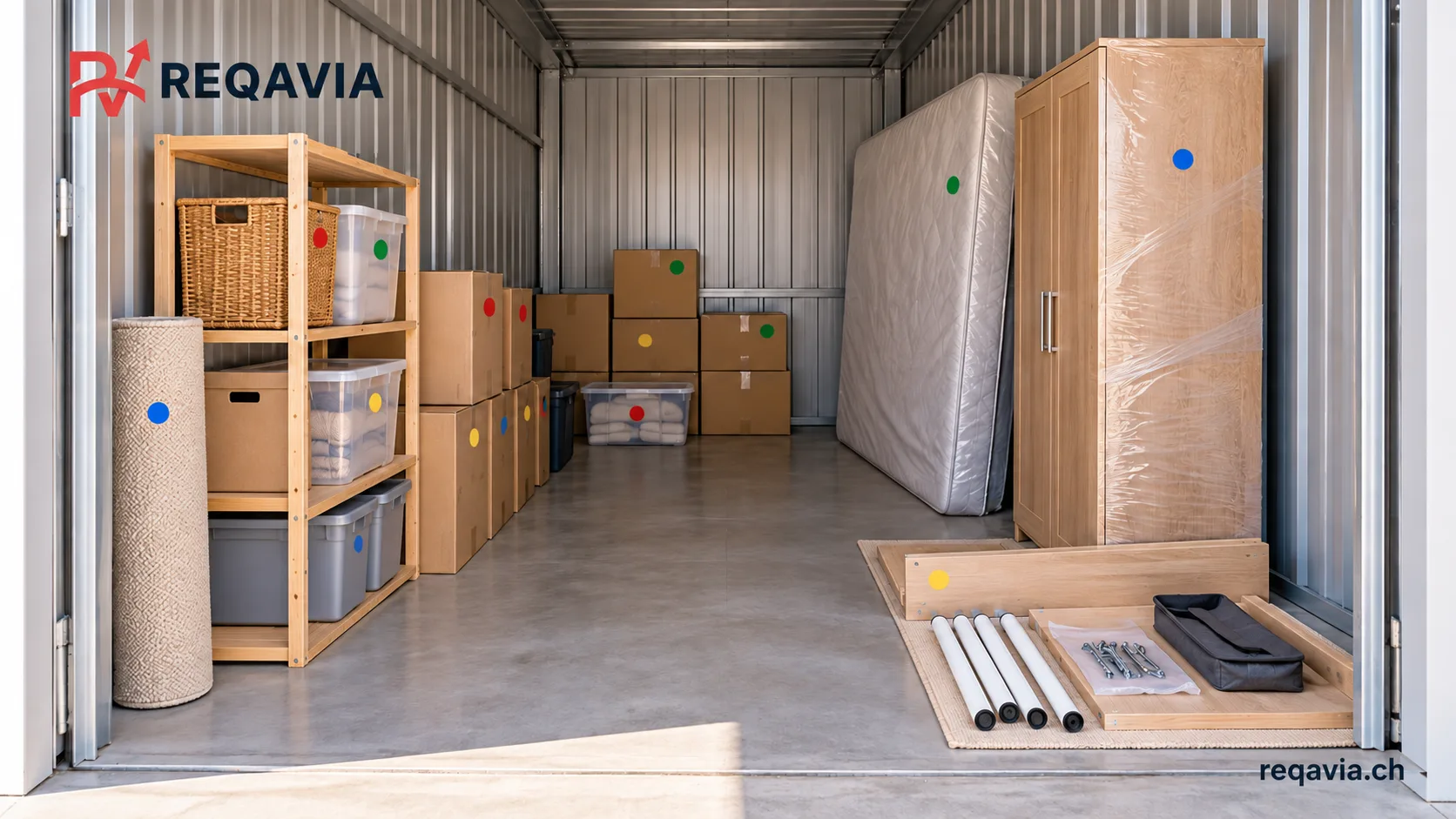
If you store a bedroom and a home office together but need the office first, arranging everything by room is not enough. Put the collection sequence at the centre of the plan: what comes out first, what stays longer and what you may need repeatedly. Otherwise, the desk can be easy to identify on your inventory yet impossible to reach without moving the bed and wardrobe.
1. Turn your inventory into collection groups
Give each group a name and an expected collection date or time window. For example, “office first”, “bedroom later” and “occasional access” are clearer than colours alone. Label the inventory and the packages consistently. Keep uncertain items in a separate decision list until you know when they will be needed; do not silently add them to the longest-stay group.
List the pieces that make each group usable. A desk includes its legs, fittings and the chair you intend to use. A bed needs the correct fixings as well as the frame. Keep associated parts identifiable without attaching labels to delicate finishes. Record where an accessory is packed rather than writing only “miscellaneous”.
2. Measure access, not just the furniture
Record the dimensions of large items in their actual stored condition, including protective packaging. Ask the operator for usable unit dimensions, the entrance opening and any access restrictions. Discuss the route from the unit to the loading area. A floor plan that fits on paper still needs enough space to remove your first group.
Sketch the entrance, the groups and the proposed access route. Ask the company arranging the unit to confirm the loading order; unloading the first-needed group at the wrong moment can undo the plan. Mark anything that must stay available throughout the storage period, and agree who can access it.
3. Compare three workable arrangements
For a single early collection, an accessible first group with longer-stay items behind it may suit. For repeated visits, separated groups with an agreed access route may be more useful. If neither arrangement gives practical access, compare a larger unit or separate spaces. Request the full cost of each option, including any handling needed for partial collections; do not assume repeated rearrangement is included.
Ask whether you may enter the unit yourself or whether staff retrieve items, how much notice is needed and whether the whole group can be presented together. These answers matter as much as the advertised floor area.
4. Keep the retrieval plan within the safety rules
Suva's [storage safety guidance](https://www.suva.ch/de-ch/praevention/nach-gefahren/gefaehrliche-materialien-strahlungen-und-situationen/sichere-lagerung-und-innerbetrieblicher-verkehr/lager-arbeitssicherheit-und-unfallverhuetung/lagereinrichtung-arten-und-sicherheitsmassnahmen) highlights falling or tipping goods, load limits and clear routes. Ask the operator to assess your proposed arrangement. Do not trade stable storage or a clear route for easier access to one box.
If reaching something would require moving tall, unstable or heavy items, stop and arrange assistance. A retrieval label is not an instruction to lift or restack it yourself. Have the company explain how the remaining furniture will be supported after the first group leaves.
5. Check the arrangement before leaving
Compare the actual positions with the inventory. Without lifting or disturbing stacks, check that every part of the first group has an agreed retrieval route. Record changes and take a few overview photos that avoid private contents. Keep a dated layout with your inventory, and update it whenever a box changes position.
After the first collection, review what remains, including the location of accessories and any changed access arrangements. Consider a smaller unit only after checking the transfer work and contract conditions.
What to put in your storage request
Describe the collection groups, their approximate quantities, large-item dimensions, expected collection dates and how often access is needed. Mention any help required with handling. You can request storage through REQAVIA using this written description. REQAVIA is an intermediary; the arrangement, price and service are agreed directly with the company. If photos would clarify the layout, share them privately with that company during coordination.