
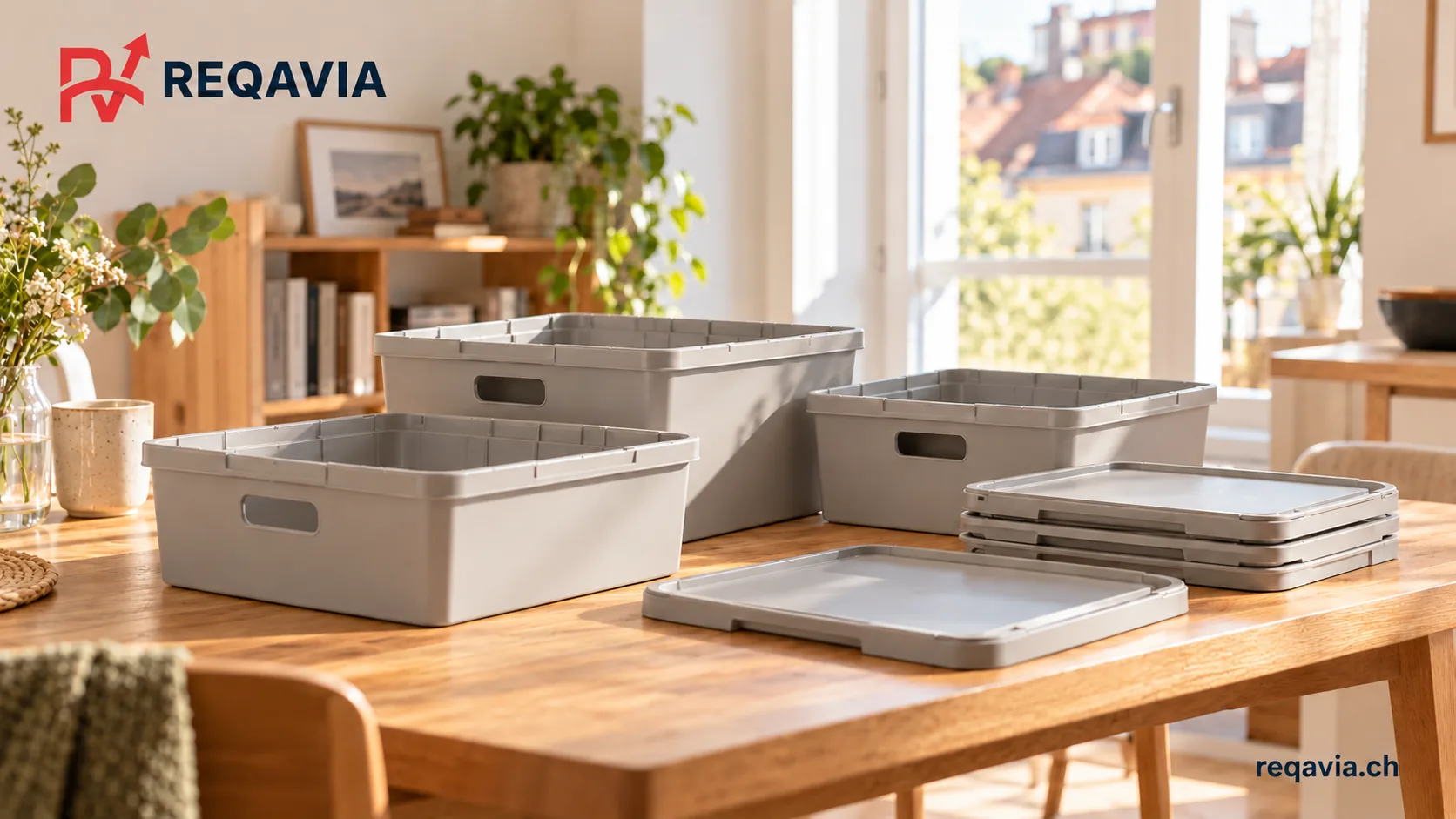
Similar-looking storage boxes do not necessarily share compatible lids. Before packing or estimating a tall stack, lay out the empty containers and identify which lid belongs to each one. Count confirmed usable sets separately from boxes awaiting identification or replacement. This gives the company a meaningful inventory instead of a quantity based on appearances.
Match the container and lid
Look for model names, size markings or other identifying features on both parts. Compare them with the information already supplied with the container. Colour alone is a weak identifier when boxes have accumulated over several years. Keep any uncertain pair out of the completed group until the fit is established.
Check the closure in the normal way allowed for that product, without forcing clips or bending a lid into place. Note cracks, distortion or missing parts. Do not treat added tape as evidence that an unsuitable lid has acquired the original closure or stacking properties. If a matching replacement cannot be confirmed, ask about a different complete container.
Record the dimensions that will travel
Measure the outside dimensions of each confirmed set, including its lid and projecting handles where relevant. Group identical sets, but list unusual sizes separately. If a box is still awaiting replacement, mark its final dimensions as unconfirmed rather than allowing it to disappear from the storage estimate.
Describe the intended contents and whether the box is already packed. A count of ten containers gives less useful information than a list showing which are bulky, frequently needed or require special protection. You do not need to put private contents on the outside; a neutral identifier can connect the physical box to your private inventory.
Do not design the layout from resemblance
Check the product information available for the intended use and ask the provider about the arrangement at the actual site. Do not infer a common stack height or allowable load from matching colours, flat lids or a photograph. If information is missing, leave the layout open for assessment rather than filling every planned vertical space on paper.
Discuss whether a suitable shelving arrangement or lower groups would work better for your contents. Tell the provider which boxes you expect to open and who will move them. A neat stack is inconvenient if every weekly retrieval requires the same several containers to be moved first. Keep doors and walking routes available in the agreed layout.
Closure is not a preservation guarantee
A lid that closes does not, by itself, prove water resistance or suitability for every material. Confirm any property that matters to your belongings from the actual specifications and discuss the storage environment with the provider. The container should be selected around the contents, rather than used to avoid checking their needs.
For an unusual collection, fragile object or unresolved preservation concern, seek an appropriate assessment before packing. Do not place an unidentified substance among ordinary household boxes while waiting to decide what it is. Explain any such item separately so the company can confirm what it accepts or identify the need for another arrangement.
Keep pairs and records together
Give each box and detachable lid a linked identifier if lids will be removed during use. Update the inventory when contents or packaging change. Keep the unmatched group visibly separate so that a helpful person does not accidentally return a doubtful lid to the packed load.
For a storage request through REQAVIA, provide the confirmed number and dimensions, general contents, expected duration and access frequency. State whether replacement containers or help arranging the space are still needed, and ask the company to confirm its offered scope. Use text in the request; share photographs privately and directly during coordination. REQAVIA is an intermediary. Prices, arrangements and execution are agreed with the company.