
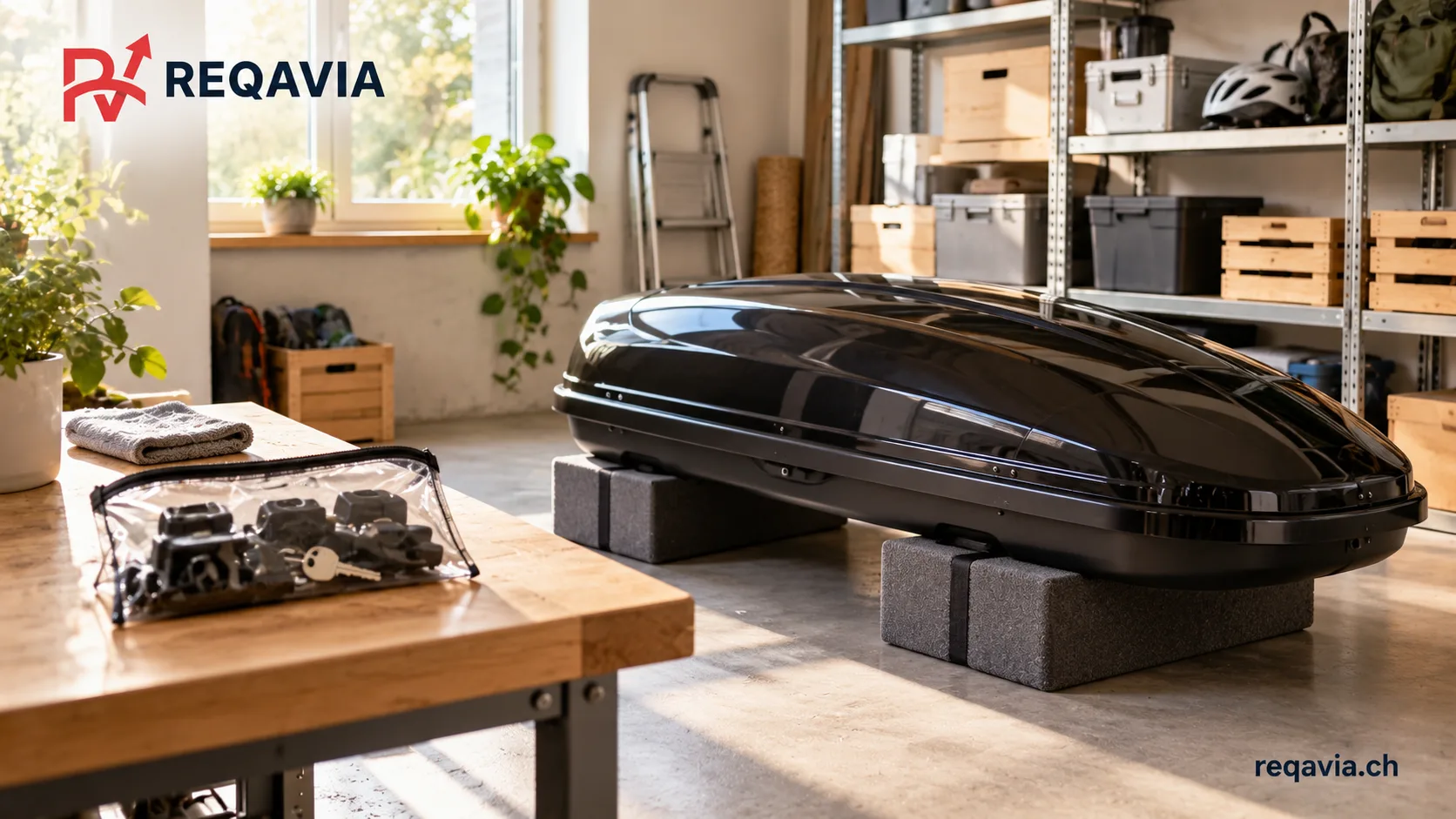
Before storing a roof box, confirm its storage arrangement and keep its key and fittings easy to find. Plan the complete equipment, not just the large shell. The actual model, its condition, the route into storage and its next use determine what needs checking. A long empty corner that appears to fit is not yet an assessed storage position for your particular box.
Identify the complete kit
Record the model and the information you already have about the box. List the fittings, adapters, internal straps and keys actually present. An assumed complete set is not an inventory of the components in front of you. Separate parts intended for different vehicles or roof-bar systems, even when they look similar. Mark an unidentified component for checking instead of assigning it to a set by guesswork.
Keep the key in a known, accessible location and link that location to the box’s inventory code in your private record. Decide who needs access when the box arrives and when it is retrieved. The precise key location and other access details do not belong on a publicly visible label. A private list with component photographs can support checking without attaching purchase or vehicle documents to the outside.
Record condition and unresolved questions
Look at visible surfaces, mounting areas and the closure without forcing a mechanism that resists movement. Record known cracks, distortion, missing components or locking problems. Those observations call for a suitable specialist’s assessment before future use. Storage does not remove a defect, and a tidy-looking box has not thereby been checked for another road journey. Keep the issue visible in the inventory rather than leaving it for departure day.
Use your own manual to establish the preparation and storage arrangements permitted for that model. This guide gives no universal hanging method, support position or load rating. Have the proposed arrangement assessed if it remains unclear. Do not plan to use the box as an improvised shelf or as a hiding place for items excluded by the storage facility. Accessories stored inside it should still appear in the inventory.
Measure the route as well as the box
Record length, width and height in the intended transport position, adding any weight stated in your existing documents. Then check doors, tight turns, stairs and access to the storage unit. Door width alone does not establish whether a long object can turn through a short angled corridor. Describe difficult sections and let the company plan appropriate handling and assistance for the actual route.
Compare offers by the position genuinely available, access conditions and retrieval process. Ask who supplies a suitable support or approved holder, and whether preparation and making the box available again are included. Avoid an arrangement that leaves the team to discover on arrival how the box might fit into inadequate space. An unresolved storage method should remain an explicit question in the request.
Plan for the next use
Note the expected travel period and the vehicle likely to be used. Following a change of vehicle or roof bars, the combination needs checking again; keeping the parts together does not establish compatibility. Arrange retrieval early enough to assess condition, components and mounting questions before departure. Treat this check as a separate task from the storage service itself.
In your text request through REQAVIA, identify a roof box with its dimensions, condition, accessories and confirmed or unresolved storage arrangement. Include access details and anticipated retrieval. REQAVIA is an intermediary; you agree prices, terms and execution directly with the company. Additional photographs can be shared with it privately during coordination. The request form uses your written description rather than image or document uploads.