
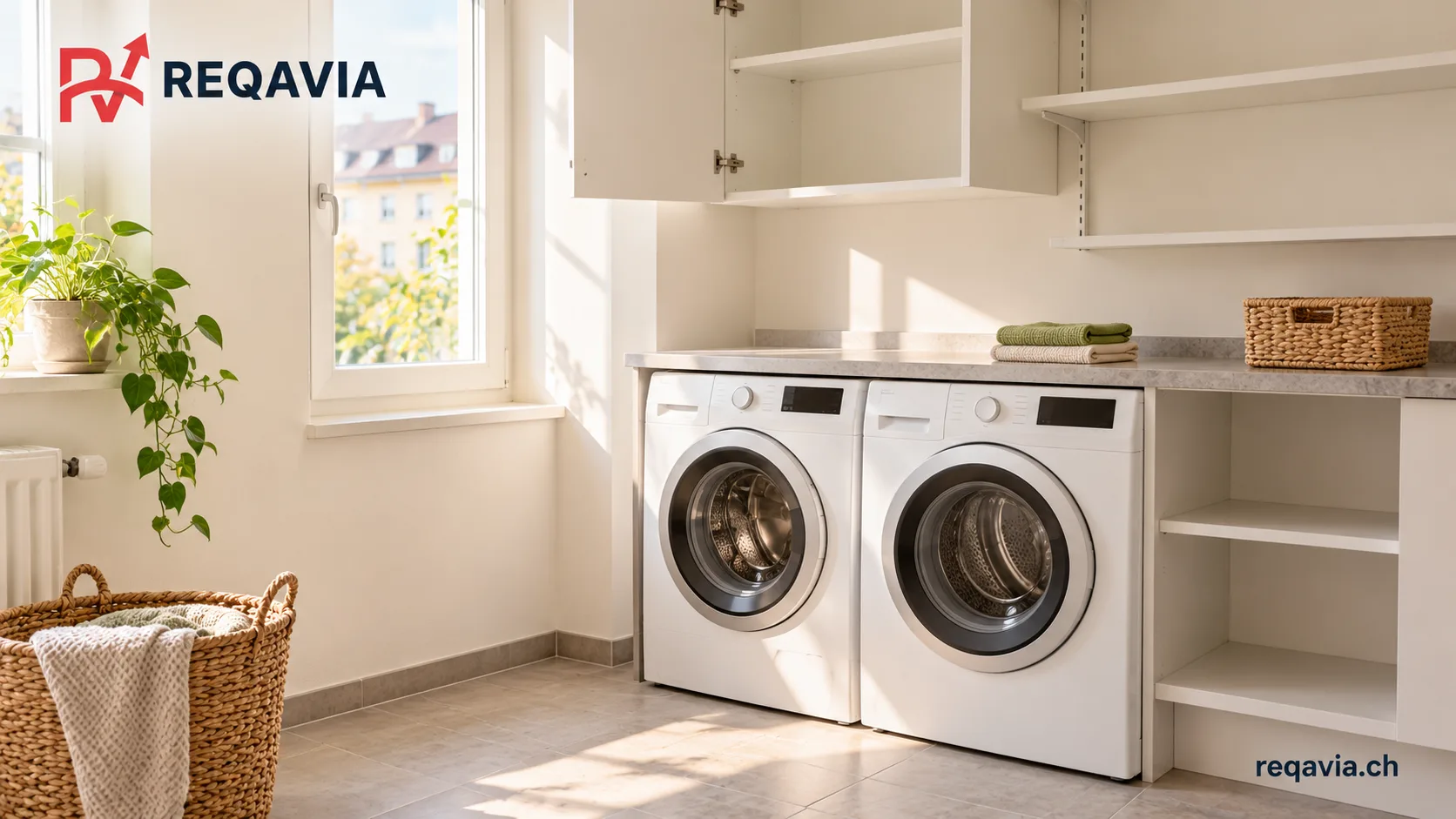
If your flat has a private laundry room, include the whole room in your moving and cleaning request. “Washing machine and dryer” leaves too much open: it does not describe the cupboards, floor, shelves or accessories. Start with two lists: what must be cleaned and what must remain at handover. This article concerns your private room; a shared building laundry requires a separate agreement about access and responsibility.
1. Describe the room before asking for a quote
Record the number and type of appliances, whether they stand side by side or are stacked, and which belong to the property. Note the approximate floor area, cupboard and shelf count, and surfaces you can identify. Mention narrow gaps, a raised plinth or furniture blocking access. A company needs to know whether the room will actually be empty, not just whether the washing has finished.
Separate personal baskets, drying racks and supplies from fittings and accessories that stay. If ownership is unclear, check the inventory or ask the property manager before packing them. An instruction booklet or attachment left on a shelf should not disappear with your moving boxes.
2. Clear products without losing their identification
Remove clothes and personal belongings before cleaning. Keep remaining chemical products in their original labelled containers and follow disposal instructions; ask your municipality about the appropriate collection route for unwanted products. The [Swiss Federal Office of Public Health](https://www.bag.admin.ch/de/sicherer-umgang-mit-chemikalien) advises against disposing of chemicals down drains. Do not leave an unlabelled bottle for the cleaner to identify by opening or smelling it.
Do not combine leftover products to save packing space. The [Belgian public health authority](https://www.health.belgium.be/de/liest-man-etikett-eines-reinigungsmittels-richtig) also warns against mixing cleaning products. Tell the company about unknown or leaking containers and arrange an appropriate assessment before ordinary cupboard clearance proceeds.
3. Distinguish cleaning from appliance work
Ask for a written description of accessible appliance surfaces and routine parts included in the service. Cleaning a front panel does not mean opening a housing, servicing a drain or moving a stacked installation. Refer to your own model instructions when clarifying what ordinary care involves; there is no single cleaning procedure suitable for every appliance.
If a machine must leave, identify who is responsible for safe disconnection, movement and reconnection. Arrange specialist work where required before promising access behind it. Do not ask a cleaner to pull a heavy appliance out simply because the floor behind it appears on your list. Electrical parts and connections are not surfaces to wash with water.
A leak, damaged connection, persistent damp patch or drainage fault needs separate evaluation by the appropriate technician or property manager. Record what is visible and do not present repeated cleaning as a repair.
4. Schedule the last wash and compare the same scope
Agree when the final wash and drying cycle will finish and when appliances can be inspected according to their instructions. Plan where the last clothes and baskets will go. A new load after the room has been cleaned may leave another task to arrange.
Compare offers against the same list: empty cupboards, accessible shelves and floor, appliance surfaces, excluded work, access arrangements and any return visit. Confirm changes to scope and price directly with the company before additional work starts.
5. Check the room after the work is finished
Walk through the agreed items and compare the remaining accessories with your inventory. Record inaccessible areas and unresolved defects separately from cleaning observations. This check documents the work; it does not guarantee the property manager will accept the handover.
For a moving and cleaning request through REQAVIA, describe the room, appliance types, postcode, floor, access, last-use timing and handover date in text. If useful, share photos privately with the company during coordination, not through the request form. REQAVIA is an intermediary; you agree the scope, price and execution directly with the company.