
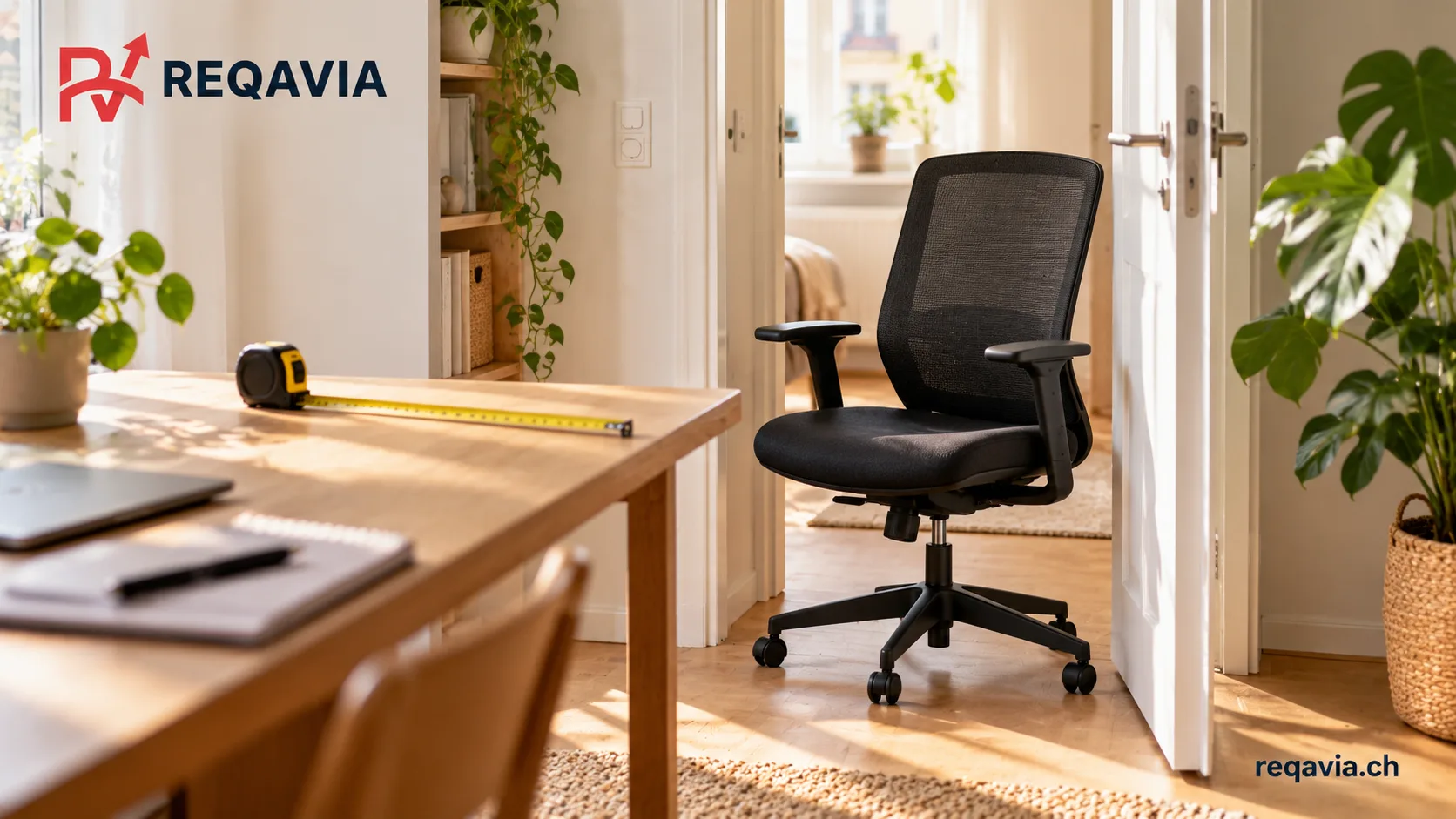
If an office chair will not pass through a doorway, stop and measure the obstruction before removing parts. The widest point may be the wheel base rather than the seat. Identify the chair and ask for an assessment of the route and any necessary preparation. A storage request should not leave someone discovering how the chair comes apart on collection day.
Describe where the chair gets stuck
Record the chair’s widest point, overall height and depth, and the usable opening along the proposed route. Include the space needed for turns before and after the doorway, thresholds, stairs and lift access. Distinguish measured dimensions from estimates. A door’s nominal size is not the same information as the opening actually available for the chair.
Note what is obstructing passage without repeatedly forcing the chair through. A photograph of the whole chair and another of the difficult turn can help the company interpret your measurements. Share those privately during coordination. Do not assume that wheels make thresholds or steps suitable for rolling the chair across.
Identify the model and its condition
Look for the model information and the instructions already supplied with your chair. Record any known fault separately: an unreliable adjustment, a damaged armrest or an issue you have not yet investigated. Being transportable does not establish that the chair is fit for use, and a clean seat is not a condition assessment.
If the model or mechanism is unclear, ask an appropriately qualified person before disassembly. This is particularly relevant where the lifting or tilting mechanism would be involved. The purpose is to establish what preparation is suitable for that chair, not to develop a generic removal method by trial, force or improvised tools.
Compare the available options
Ask whether another authorised route or a different handling arrangement could avoid dismantling. Provide the actual building constraints so the person assessing it can decide. Do not promise access through a neighbour’s room or another restricted area before obtaining the relevant agreement.
If preparation is needed, confirm who carries it out, when it will happen and what is included. Separate assessment, disassembly, transport, storage and later reassembly in the offer. Ask whether a specialist must act before collection. A company accepting a chair for storage has not necessarily offered repair or model-specific technical work.
Keep separated parts linked
Give the complete chair one inventory identity. If suitable preparation separates components, link every package of parts and fasteners to that identity. Record who prepared it and retain the relevant instructions. Photos before and after preparation can clarify which components belonged together without serving as a substitute for assembly guidance.
With several similar chairs, avoid a shared box labelled only “office parts”. Keep each chair’s pieces distinguishable and note anything missing. Ask how the prepared chair and associated packages should be protected and stored. The fact that a component can be detached does not establish that it can be packed anywhere or combined with another model.
Decide whether storage still makes sense
Consider its next use, suitability for the intended workspace and whether an unresolved repair affects your decision. Compare a real storage offer with assessment or repair options you have actually obtained. If you choose to pass it on, describe its known condition honestly and confirm the recipient’s acceptance.
For storage through REQAVIA, describe the model if known, measured dimensions, difficult access, known faults and preparation already completed or still needed. State the intended duration and whether the chair must be retrieved separately. Photos can be shared directly and privately with the company. REQAVIA is an intermediary; scope, price and execution are agreed directly with the company.