
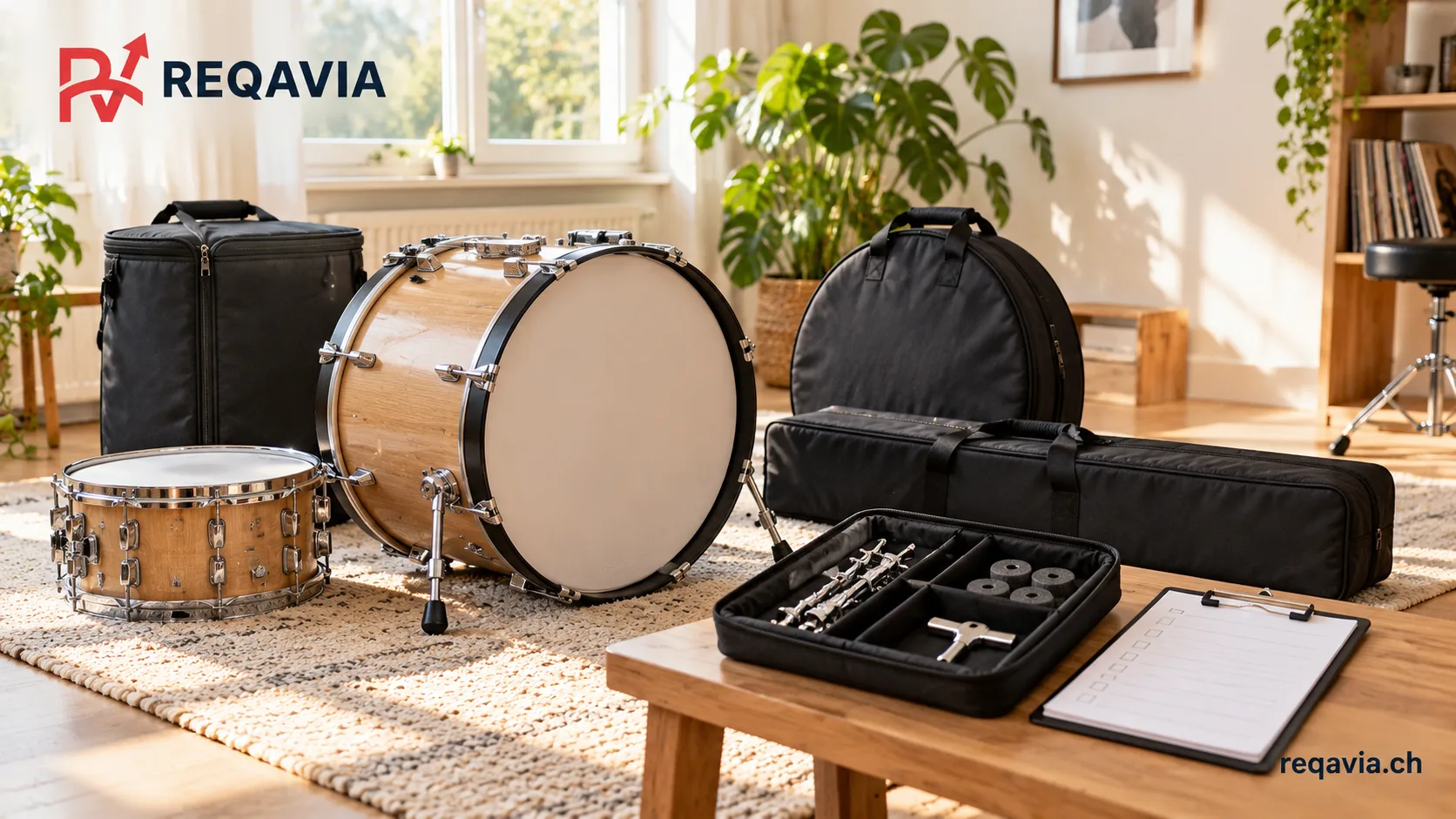
Every large case has arrived, but a connector for a cymbal stand is missing: the drum kit is not yet usable as intended. Before dismantling it, inventory the stands, pedals and associated small parts too. Photograph the assembled layout and connect every item to its package. Receiving the delivery can then mean checking the actual equipment, rather than simply counting large pieces of luggage.
Turn the assembled kit into a traceable inventory
First describe whether the kit is acoustic, electronic or hybrid. List drums, cymbals, stands, pedals, stool and accessories separately. For electronic components, add modules, power supplies and cables. A photograph does not replace the list: a hidden pedal or small bracket may not appear. Record damage or missing parts already known before the move.
Give every package a distinct reference and record its contents. Where several small parts belong to one stand, retain that link even when they are protected separately. Put identification on the packaging and avoid adhesive on sensitive surfaces. Avoid a shared bag of unidentified screws and connectors that must be deciphered only after arrival.
Resolve borrowed items and protection before collection
For borrowed cymbals, pedals or stands, record the owner and agreed destination: return, remaining in the rehearsal room or authorised transport. Keep that list separate from your own belongings. Resolve uncertain ownership before packing. An item beside your kit does not automatically belong in your moving order.
Match each bag or case to its intended contents and identify parts without protection. Have missing or unsuitable packaging assessed. Fewer bags are not an advantage if accessories become difficult to identify or poorly protected. Do not assume drums can be nested together or that every component can be freely dismantled. Consult your own manuals and obtain competent advice where the construction is unclear.
Show the company the actual transport task
Provide the expected package count, external dimensions of the largest fully packed cases and known weights of stand or accessory bags. Clearly identify unconfirmed weights. For both addresses, describe the floor, stairs, narrow doors, lift and route to the vehicle. Tight passages or difficult-to-assess containers call for an assessment of access and handling beforehand.
Suva’s prevention guidance recommends planned handling and suitable aids for heavy loads. Agree who packs, what dismantling is included and whether the job ends with delivery or defined reassembly. Arrange any tuning or musical setup separately with someone competent; do not assume the furniture mover will provide it. Compare quotations against the same inventory and scope of work.
Suva: prevention guidance for handling heavy loads (in German)
Coordinate the final rehearsal and first use
Set the point when the kit will stop being used and become available for preparation. If particular items are needed for an upcoming performance, identify them as a separate, accessible group. If the kit travels with the rest of the household, allow time to locate its cases, unpack and check that everything is complete before a fixed rehearsal or performance.
At the destination, choose a suitable area for checking the group without mixing it into other moving boxes. Compare references and package counts first, then contents and visible condition. Document missing or damaged parts precisely. Do not improvise unsuitable replacement connections simply to start playing immediately; have unstable or damaged components assessed.
Send a clear moving request
In your text-based request through REQAVIA, describe the kit type, expected packages, largest dimensions, access, date and preparation you will handle yourself. Explain where packing or assembly help is needed. Photographs of the assembled kit can later be shared directly and privately with the company. REQAVIA is an intermediary: agree the scope, price, terms and execution directly with the company. Ask for a quotation covering the complete equipment list.