
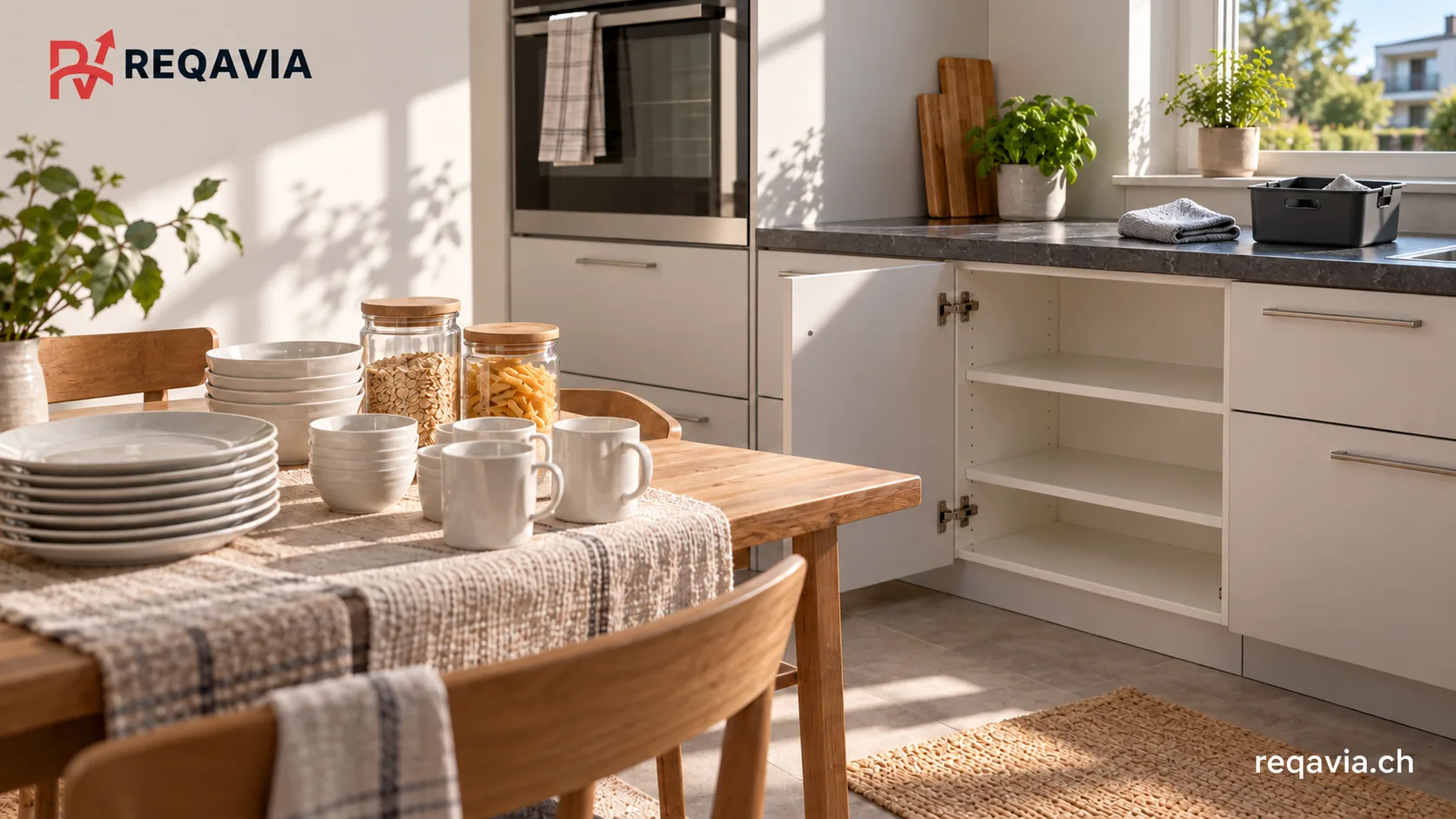
Before arranging an inside clean of your kitchen cupboards, decide whether the job covers empty surfaces only or also moving and replacing their contents. These are different tasks. If every cupboard is emptied at once, the kitchen may run out of safe temporary space. Agree a small working area, a sequence and who decides what will be put back.
Describe cupboards and contents separately
Count the cupboards, drawers and shelves to be cleaned. Distinguish high wall units, low units, corner cupboards and any difficult-to-reach sections. Give approximate sizes and say how full each group is. A cupboard holding two light containers needs different preparation from one packed with crockery, food and small appliances; the description should make that difference visible.
Confirm whether the work includes shelf surfaces, sides, backs, corners, door interiors, handles or drawer runners. Do not assume that the visible fronts, appliance interiors or cupboard tops are part of an internal clean. Mark exclusions clearly. Ask whether removing shelf liners or adhesive residue needs a separate assessment rather than treating it as an ordinary wipe.
Choose who handles each stage
There are three practical arrangements: you empty and refill while the company cleans; the company handles all agreed stages; or you share the work cupboard by cupboard. Compare the complete sequence, including handling fragile items, temporary storage and putting everything back. Clarify who supplies suitable containers and who checks that contents return to the correct place.
Keep decisions about food, valuables and unwanted items with you or a clearly designated person. Give explicit instructions for anything that may be discarded. The cleaning team should not have to judge the condition of your food or decide which family items matter. Leave uncertain objects in a separate decision group instead of quietly adding them to the waste.
Keep part of the kitchen available
Work on one cupboard or a small group at a time. Prepare a clean, stable surface for its contents away from the floor and the route through the kitchen. Keep items needed that day accessible. A private photo of the original shelf arrangement can help if you want the same layout restored, without photographing personal documents or unrelated rooms.
Keep food labels and packaging identifiable; do not transfer contents into unknown containers simply to make room. Group matching lids and parts with their items. For high cupboards, agree safe access with the company. The [BFU's prevention advice](https://www.bfu.ch/de/ratgeber/putzen) recommends a stable stepladder and rejects chairs, crates and stacks of books as substitutes.
Do not turn cleaning into unplanned repairs
Identify removable shelves or drawers using the cupboard's care or assembly instructions. Do not force a part that resists or mix fittings from different cupboards. Record existing swelling, loose hinges, damaged edges and unstable shelf supports before the visit. Ask the company to assess the surface and method; arrange a qualified repair where the problem is structural rather than dirt.
Repeated insects, unusual traces or dampness require a different decision from ordinary crumbs. The [City of Zurich's pest guidance](https://www.stadt-zuerich.ch/de/gesundheit/gesundheitsschutz/schaedlingspraevention/faq.html) stresses identifying the species before treatment. Its [advice service](https://www.stadt-zuerich.ch/de/gesundheit/gesundheitsschutz/schaedlingspraevention/beratung.html) also cautions against immediately reaching for insect spray. Record what you see and seek appropriate advice; do not ask a cleaner to spray a food cupboard indiscriminately. Arrange suspected leaks or persistent dampness for separate assessment.
Finish with a usable kitchen
Return contents only when the surfaces and care instructions allow it. Keep shelves and fittings in their intended positions and have any uncertainty about heavy loads assessed. Check the agreed corners, edges and interiors, then note inaccessible areas and anything left outside the cupboards. Confirm who completes refilling if drying or a separate repair extends beyond the visit.
In a REQAVIA cleaning request, describe cupboard and drawer numbers, fullness, the parts you will empty yourself and the handling you want included. Mention delicate surfaces, access and any unresolved signs of damage. The request is textual; useful photos can be shared later privately with the company. REQAVIA is an intermediary, and you agree scope, price and execution directly with that company.