
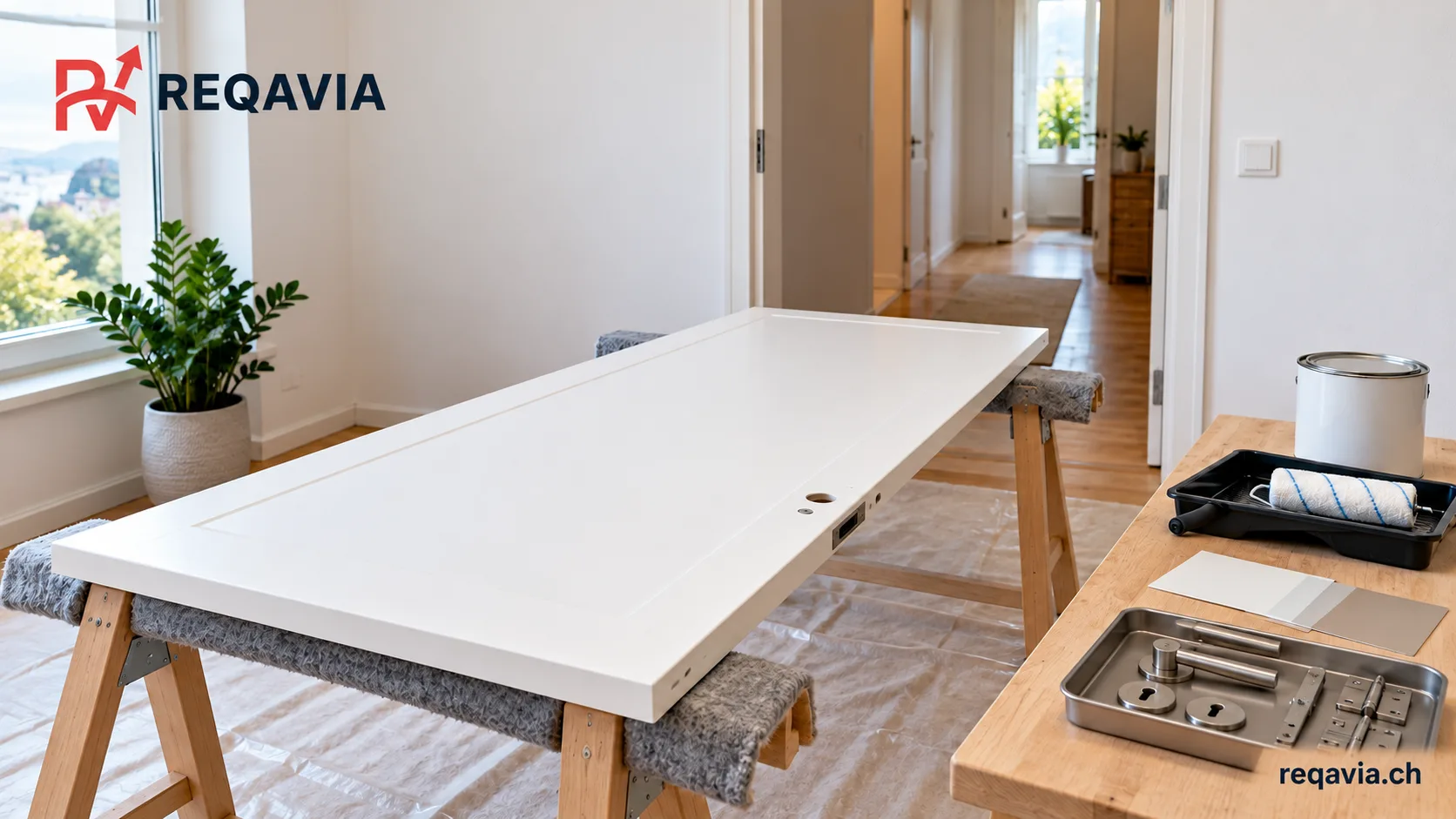
If one company proposes taking your doors to a workshop and another would paint them at home, compare the complete job. You need a finished door that is correctly refitted and works. First identify which doors can be absent and which rooms must remain usable. That makes the choice of working location a practical decision.
1. Record each door and its condition
Make a list covering the room, number of door leaves, approximate dimensions and known material. Note glazing, fittings and existing damage. Specify whether both faces, edges and frames are included. A frame that stays in the flat needs work on site; it should not disappear from the comparison between two quotations.
Record doors that already rub, hang unevenly or fail to close properly. Ask whether correcting these faults is included or requires separate assessment. In rented accommodation, clarify the proposed work and colour change with the relevant landlord or property manager beforehand. Do not assume that agreement to painting also covers other alterations.
2. Test both options against daily life
For a workshop job, agree the removal and return dates. Consider bathroom and bedroom privacy, access to rooms and whether the work could happen in stages. Who identifies each door, keeps its fittings together and arranges transport? A missing door should not become a surprise on the day it leaves.
For work at home, agree the working space, coverings, ventilation and routes through the flat. Where will children and pets stay during the work? Which rooms will be temporarily unavailable? Ask how dusty preparation and paint application will be organised. The location alone does not establish the likely price or the quality of the finished result.
3. Resolve safety questions before preparation
Have unknown old coatings assessed before sanding or stripping them yourself. [Suva’s prevention guidance, in French](https://www.suva.ch/fr-ch/download/regles-et-conseils/regles-vitales-pour-les-platriers-peintres-identifier--evaluer-et-manipuler-correctment-les-produits-amiantes/regles-vitales-pour-les-platriers-peintres-identifier--evaluer-et-manipuler-correctment-les-produits-amiantes--84052.F), identifies primers, paints and varnishes among past uses of asbestos. This does not mean every old door contains it; assessment should address the particular work proposed.
For a fire or security door, discuss removal and treatment with an appropriately qualified specialist and the relevant property manager. [CIPI’s guidance, in French](https://www.bfb-cipi.ch/fr/conseils-prevention-incendie/detail/portes-coupe-feu), explains that a fire door provides its protective function only when closed. Its temporary removal therefore needs a different assessment from that of an ordinary internal door.
4. Agree the finish before work starts
Confirm the colour and sheen using a suitable sample. Discuss whether wood grain should remain visible, which defects will be repaired and how the door leaves will match frames left at home. Ask what preparation and coating are proposed for the existing surface. A colour name alone describes neither the surface appearance nor the extent of repairs.
5. Compare quotations through to normal use
Check for removal, identification, packing, transport, protection, preparation, painting, fittings, refitting and clearing up. Get exclusions and responsibilities in writing. Agree how additional damage will be reported and how any extra work will be authorised. Comparing only a price per door can hide significant differences in the job being offered.
Also ask when doors may be transported, closed and used normally. Instructions should relate to the actual coating and working conditions; do not assume a universal drying period. Establish who confirms the dates and whom to contact if the return is delayed.
6. Check the doors after refitting
In suitable light, inspect the agreed surfaces, then check opening, closing, handles and locks. Record concerns against the relevant door and agree the next step with the company. Do not force a door that sticks.
For a painting request through REQAVIA, describe the doors, scope, access and essential room use in the text. If photographs are needed, share them privately and directly with the company during coordination. REQAVIA is an intermediary; agree the services, price, dates and execution directly with the company.